

Almost all the run training plans, irrespective of the distance or goal, are largely based on the heart rate (HR) zones. With the advent of heart rate monitors (HRM), and now, smartwatch integrated wrist HRMs, HR data is very well tracked and available. However, it’s surprising to see a vast majority of runners not aware of their HR zones and therefore (obviously!) not training as per these. While the running watches do set up the HR zones automatically based on the run history, there are hardly any runners who actually reset these zones to more precise ranges, which is always advisable.
It is very easy to find out the HR zones so I have always wondered why runners aren’t using them more often.
In this article, I share two simple methods to set these up. All that is needed is a bit of a run, some math, and a heart rate monitor!
1) General Age and Resting HR based method
This method just needs math and that’s about it. No need to run – nothing! And, hence the name general. This is a good starting point and surely better than not having anything.
Step 1: Note your Age in years (round down if you want to!)
Step 2: Note your resting HR (RHR)
There are two ways of doing this:
- If you have a running watch or a smartwatch with active HR tracking, there is a high chance that it has RHR. If yes, please use that as it is.
- In case you cannot find this on the device, here is a simple way. Head to a quiet room & lie down for about 5 mins and relax your breathing. After 5 mins, place your finger on the wrist and count the beats for 30 seconds. And then simply double that count. For eg: If you counted 30 beats in 30 seconds, your RHR = 30 X 2 = 60 beats per minute (bpm).
Set 3: Armed with these two data points, you can unleash some basic math to get to your HR zones.
Just download the zone calculator from the link below and input these two details. Voila, you’ve got your HR zones!
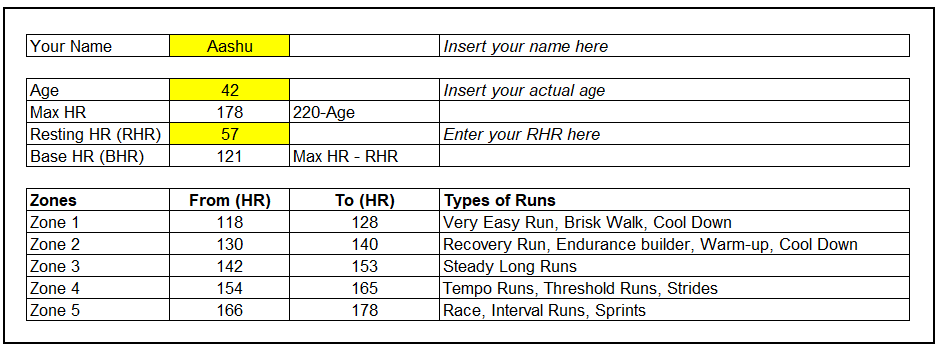
As an example, at the time of writing this, my age was 42 and RHR 57 so this is how my HR running zones pan out:
2) Lactic Threshold-based HR Zones
This is a scientific and most widely adopted method for setting the HR zones. This method was devised by legendary endurance athlete Joe Friels. This method requires a bit of a run (well a tough one), a heart rate monitor, and some math.
Step 1: Prepare for a 30 min all-out run with a 5 min warmup and stretches. This has to be a solo run.
Step 2: Run at a full-go (all-out) for the next 30 minutes while heart rate recording is on all through. After 10 mins, press the lap button on your watch. We do this because we want to measure the HR for the last 20 mins only.
Step 3: Check the average HR for the final 20 mins of the run and note that down as LTHR. For curious folks, LTHR is the lactic threshold HR, which refers to the HR zone where your body starts producing more lactic acid than its ability to clear it out.
Step 4: Armed with this data point, you can unleash some basic math to get to your HR zones.
Just download the zone calculator from the link below and input LTHR. Voila, you’ve got your HR zones!
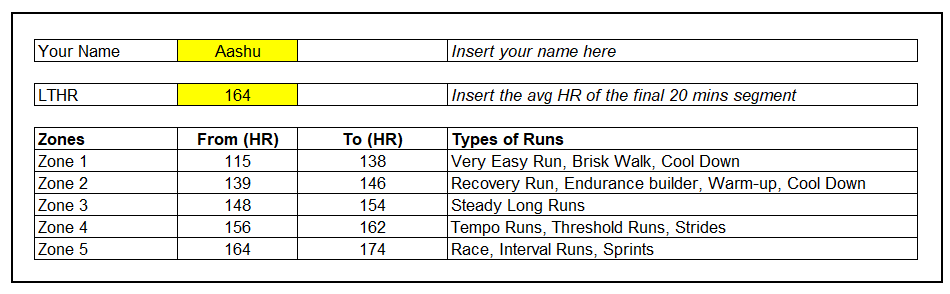
As an example, at the time of writing this, my LTHR as per the test above was 164 so this is how my HR running zones pan out:
There are many more methods available for figuring out the running HR zones. But, I personally find the above 2 methods the easiest. With running HR zones available, a runner can tailor the running plan precisely based on individualized HR zones and see a drastic improvement in running performance.
Runners should keep checking and updating their HR zones every once in a while. With more training, there will be improvements in the zones. One can plan using the second method in this article and revisit HR zones every 6-8 weeks!
Please do bear in mind that after the initial gains, the zones are fairly sticky and hence you may not see a significant drop in the HR limits!
Happy Running!
Please note that the methods shared above are widely acceptable general methods for determining the running HR zones. This is meant for the consumption of recreational and amateur runners! This information is meant to be one of the several generic guidance which can help you evolve into mindful and therefore, a better runner. Please do not construe this as a piece of specific expert advice customized to your body and requirements!
Every runner is different and hence there are bound to be peculiarities with each one of us so it is possible that some of these generic methods may not apply to your body. If you are into serious competitive training or find that these zones are not working for you, kindly consult experts like your running coach or certified doctor for more specific advice.
Discover more from On The Run with Aashu
Subscribe to get the latest posts sent to your email.
 On The Run with Aashu
Leave a comment