
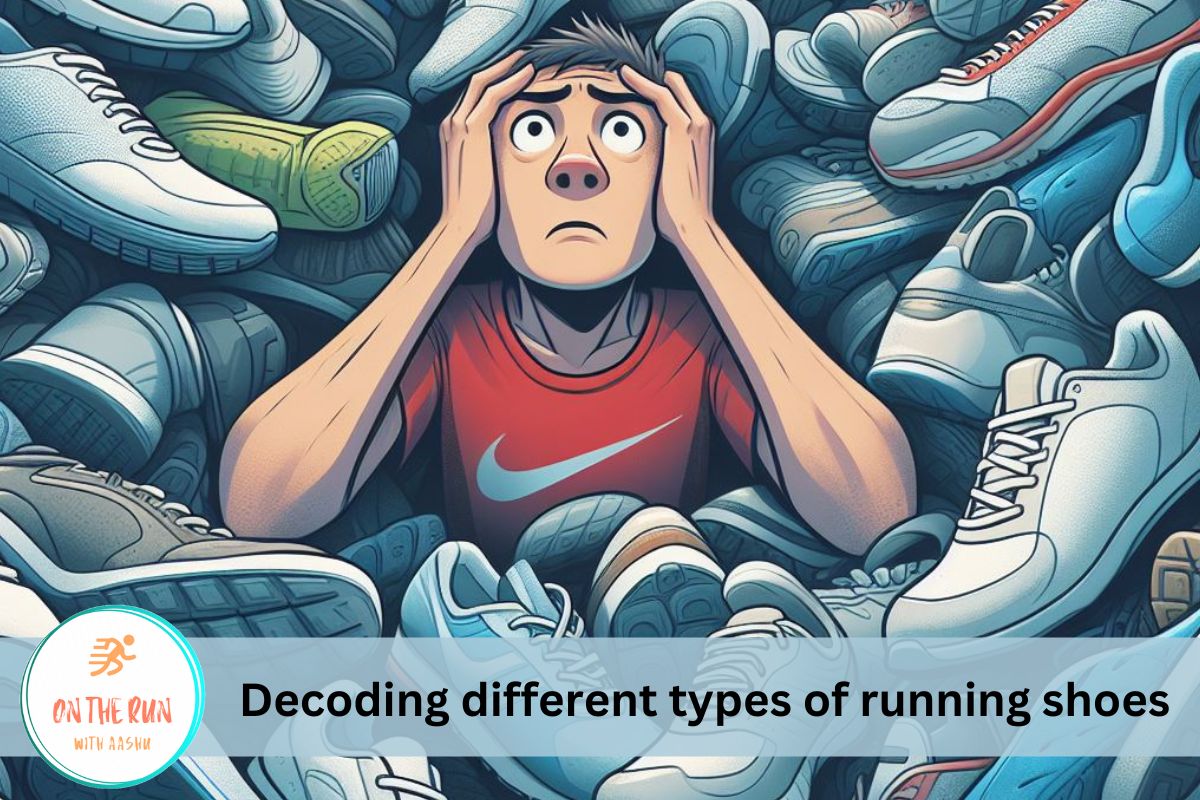
Running is a simple sport but with the continuous advancement in technology & training science, it is getting more technical every passing year. Technology and science rules when it comes to running shoes, apparel, and training methods. And with that comes complexities and confusion. It is worth spending some time unraveling and simplifying some of these complexities. So, here is my attempt at decoding various types of running shoes based on the use cases.
There are three broad types of shoes based on the training use cases:
- Daily Trainer
- Speed Workout Shoes
- Race Shoes
1. Daily Trainers
As the name suggests, these shoes are designed for day-to-day runs. They are subjected to the highest mileage-related wear and tear.
They are built for maximum comfort, so they will feature oodles of cushioning and support and will be on the heavier side – possibly above 250g. They are also built for durability, so they will withstand the highest mileage. One can easily pull the daily trainers in the range of 800-1000 km without any issue. These are relatively less expensive shoes – mostly in the price range of INR 8,000 to INR 12,000.
A typical runner spends 90%+ of the time and distance in training and the rest for racing. Around 70-80% of the time of training is spent on easy day-to-day runs. Here is where daily trainers come in.
As a runner, daily trainers are your go-to shoes most of the time.
2. Speed Workout Shoes
About 20-30% of the training is dedicated to improving/optimizing running speed. Typical workouts here are interval training, fartlek, Vo2 max runs, and so on. All such training is typically done using speed workout shoes. As the name suggests, these shoes are designed for sessions where you have to run faster (not necessarily races). Therefore, they are built for speed and performance.
They are typically lightweight – mostly in the 220g to 280g range. They are also not built to last longer and would typically clock 700-800 km mileage without any performance degradation. These shoes are also relatively more expensive compared to the daily trainers – possibly in the range of INR 10,000 to INR 18,000.
As a runner, speed workout shoes are going to be your second most-used shoes after the daily trainers.
3. Race Shoes
As the name suggests, race shoes are designed for races. They are built for maximizing speed and race-day performance.
These are usually very lightweight – possibly in the less than 230g range. They also sacrifice a bit more on comfort, so they will be less forgiving. These shoes are also not built for durability, and therefore, their usable mileage is far lower than the other types of shoes – mostly under the 400-500 km range. Some of the newer concept race shoes are built to last only one marathon!
These shoes are loaded with the most advanced technology with the single-minded focus of helping you run the race as fast as you can. Needless to say, these shoes are the most expensive of the lot – possibly in the price points above INR 15,000.
As a runner, you will spend the least amount of time in the race shoes. These are your prized possessions, and you will preserve them the most.
Here is a simple comparative summary:
| Parameters | Daily Trainers | Speed Workout Shoes | Race Shoes |
| Suitable for | Day-to-day easy to medium-paced runs | Intervals, Tempo, Fartlek | Race Day |
| Comfort | High | Medium | Medium to low |
| Speed Performance | Low to medium | Medium | High |
| Weight | Heavy to medium | Medium | Light |
| Mileage | High | High to medium | Low to medium |
| Cost | Low to medium | Medium to high | High |
Other specific types of running shoes:
A) Stability Shoes
Stability shoes as the name suggests are designed for providing extra stability to the feet. These shoes are specifically designed for running with pronation (feet rolling inwards or outwards during the strides), flat foot, or low arch.
They are usually on the heavier side with lots of cushioning and support to help stabilize the high impact points of the feet.
B) Trail Shoes
Trail shoes are designed specifically for running in the trails – rough and uneven surfaces. These shoes are specifically designed to provide solid grip in the sole along with a snug fit to provide support to the ankle.
Trail shoes are usually on the heavier side with specifically designed sole to enhance grip while striding. They also feature a firmer outsole with stiffness around heel and ankle.
Now that we know these different types of shoes, there will be an obvious question. Let’s look at some of the most common queries.
1. Does shoe really make such a huge difference in performance?
The answer is a resounding YES. Purist runners may not fully agree, but there is enough data and science to prove this. Across all types of runners – from beginners to elites, there has been drastic improvement in running performance with advanced technologies like lightweight foam, tall stack height, carbon plates, etc. Running fitness is not just about pace. It is also about staying free of injuries and recovering faster. Having the right types of shoes helps along these as well.
2. Do we really need to have three types of shoes all the time?
The answer is NO. Running as a sport is a great leveler. There are no rules about the type of shoes. One can very well run a race wearing daily trainers and possibly do an easy run with race shoes.
For folks looking to improve their running performance, and who have set out ambitious goals, it is recommended to use different shoes for different types of training runs and races. Doing so is more likely to make the runs more productive and improve running fitness. There are enough and more studies proving this. Therefore, the running shoe brands are spending millions on R&D to churn out shoes for each type of run.
3. Why do we need a speed workout shoe? Can we not use the race shoes for the same?
Yes, one can surely use race shoes for speed workouts. The only glitch here is that race shoes are very expensive and have limited high-performance mileage in them. You would rather use them more exclusively for the races than ‘waste’ the valuable mileage in speed workouts.
4. All the running brands have so many options available these days. How do we know which shoes are for what purpose?
It is indeed difficult to figure out which shoes are for what given the plethora of options available across all the brands. Also, brands do a shitty job of classifying their shoe assortment properly across the use case categories, making it more difficult for the runners to decipher.
One simple way to figure out is to simply check the brand outlet. Their sales reps are trained to provide this guidance. But I have seen some of them mis-sell too, so exercise caution on this front.
Another way would be to simply look up the internet for reviews of the shoes. There are credible websites with reviews of all the shoes and deciphering this for the regular runners.
And finally, recognizing this problem, I am going to write a piece on shoe classification covering all the major brands available in India. I also intend to keep updating the same as brands introduce newer models.
If you liked reading this peice, may I request you to share this within your network and help other runners become more aware about the different types of running shoes. Also, having more readers would motivate and inspire a hobby writer like me to write more. Thank you!
Discover more from On The Run with Aashu
Subscribe to get the latest posts sent to your email.
 On The Run with Aashu
Leave a comment