
A thought experiment
Let’s begin with a simple thought experiment: look back on your running journey and compare two 10K runs that had similar finish times and race conditions. While many parameters such as pace, mileage, and average heart rate will be the same, there is likely a noticeable difference in how you felt during these runs—specifically, the effort you exerted.
Data v/s Feel
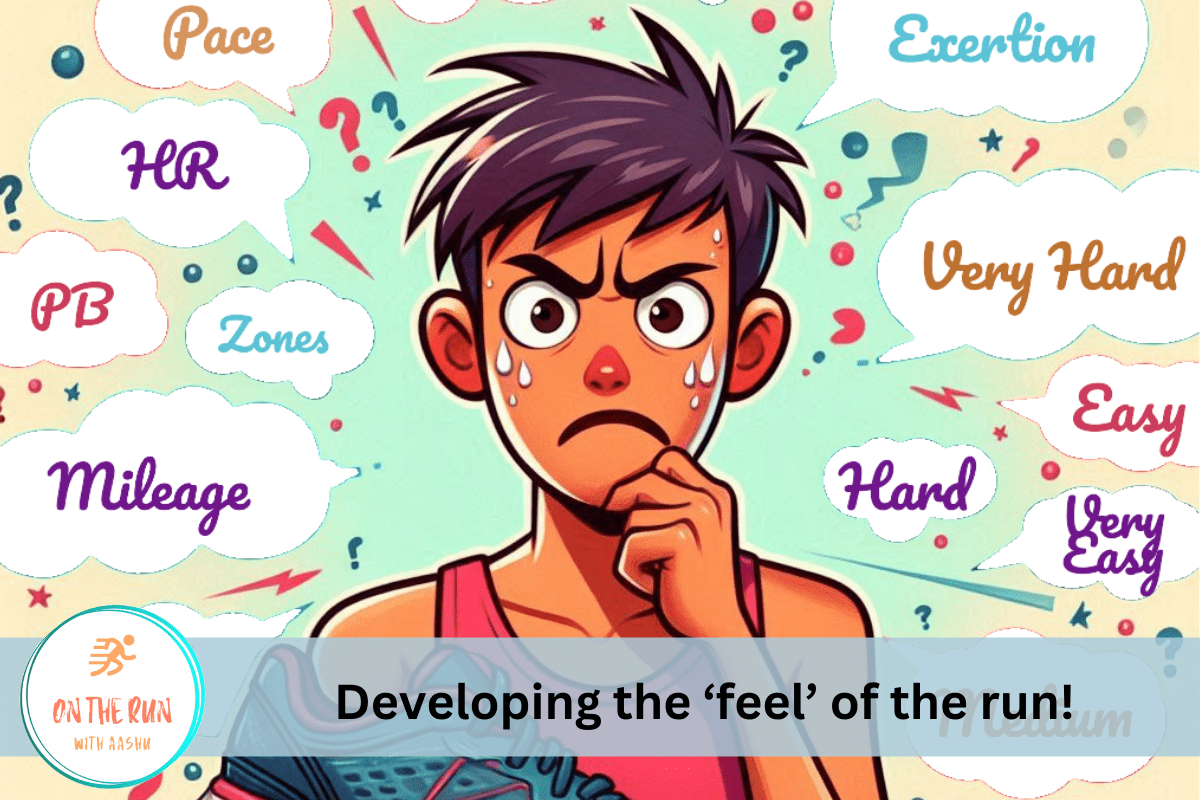
Runners mostly focus on data, metrics, and statistics. Terms like mileage, pace, heart rate, heart rate zones, thresholds, personal bests, personal worsts, training load, and recovery time are part of their everyday vocabulary. However, the machine that powers our runs is biological—our hearts, lungs, brains, muscles, bones, tendons, and ligaments. Have you ever wondered how this engine operates? It doesn’t rely on data but rather on something more organic: the concept of ‘feel’.
Our hearts don’t understand pace, our muscles don’t operate based on mileage, our lungs aren’t aware of thresholds, and our entire body doesn’t recognize personal bests or worsts. The only thing that truly matters to this biological engine is the ‘effort’ of the activity. Therefore, it is crucial to be as aware of your effort during a run as you are of the other parameters.
Rated Perceived Exertion (RPE)
The ability to accurately perceive effort of a run is a hallmark of a skilled runner. This perception is like a ‘muscle’ that every runner must develop. It requires a tremendous amount of self-awareness—being attuned to how your body responds under varying conditions.
One of the best tools for measuring the running effort is Rated Perceived Exertion (RPE) scale. This was developed by a Swedish researcher named Gunnar Borg. It was orginally a 20 point scale which was modified later to a 10-point scale. It describes the feel or effort of an activity, ranging from very easy to very hard. It’s not about data but rather a qualitative view of your run.
To make it even simpler, I’ve condensed this 10-point scale into just 5 easy-to-remember levels. Here they are:
| RPE Scale | The Feel | What it feels like |
| 1-2 | Very easy to Easy | I am holding back and not pushing at all. I can talk comfortably during the run. |
| 3-4 | Easy to Comfortable | I am neither pushing nor holding back. I can comfortably talk during the run. |
| 5-6 | Medium | I am pushing in this run but still in control. I can talk during the run but with some effort. I can maintain this effort for 30-60 mins. |
| 7-8 | Hard | I am pushing hard and I can feel the effort in every step. I am unable to talk except in a few words. I can maintain this effort the next 15-20 mins. |
| 9-10 | Very Hard | I am at my maximum effort and want to stop soon. I can barely speak and I am gasping for air already. I can maintain this effort the next 1-2 mins only. |
Building the RPE intuition
One way of developing the intuition about the effort or feel is to force yourself to rate all your runs across this scale. This is a common feature in most running watches and it can be documented in Strava too. In addition to the rating, it might also make sense to write a few points about the run. The intuition will build slowly and steadily.
It may be a good idea to do a few runs without looking at the watch at all – it’s harder than you think! And then take a guess at the effort and pace to compare with actual data later. Do this every once in a while. I know some awesome runners who purposefully slot in a no-watch run in their training plan – it is called ‘running with the feel’.
If you are able to guess the pace right consistently, you know you are getting the ‘feel’ of the run.
The benefits
Understanding the ‘feel’ of a run offers numerous benefits, enhancing both your performance and enjoyment. As your running fitness evolves, so does your self-awareness. Here are some of the key benefits:
a. Fewer Injuries
By grasping the ‘feel’ of a run, you become more attuned to your body’s limits. You can recognize when your effort exceeds your current fitness level and mindfully decide to stop. Most injuries occur because runners don’t know when to stop pushing.
b. Better Endurance
Building running endurance involves challenging your body’s system in a controlled manner to achieve incremental and sustained improvements. Understanding your effort helps you push your body to the right limit, enhancing your endurance.
c. Improved Speed
Speed improvement requires a mix of low, medium, and high-intensity runs. The 80-20 rule, which suggests a mix of 80% slow and 20% fast runs, is a classic approach to speed training. Greater awareness of your effort ensures better adherence to this structured training, leading to more significant speed benefits.
d. Joy of Running
A mindful run can bring immense joy. In a world overwhelmed by data, running can sometimes feel like a chore. Running by feel allows you to consciously detach from data and simply listen to your body, enhancing the joy of the experience.
This is not a sponsored post. It comes from years of experience in running along with my own research on the topic. If you have read this far, thank you! If you found this helpful, please share it within your network. For feedback or inputs, DM me at aashutosh[dot]chaudhari[at]gmail[dot]com. I will surely get back to you.
Discover more from On The Run with Aashu
Subscribe to get the latest posts sent to your email.
 On The Run with Aashu
Leave a comment