

What could possibly link the world’s most famous fictional detective to the world’s first standard-distance marathon? The answer lies in Sir Arthur Conan Doyle, the creator of Sherlock Holmes, who immortalized not just a story but a man—Dorando Pietri.
This is no mystery tale but a true account from the 1908 London Olympics. Doyle’s masterful writing turned the dramatic end of that marathon into a narrative of courage and human endurance, elevating Pietri, an exhausted yet determined Italian runner, to legendary status.
The 1908 Olympic Marathon
The London Olympics in 1908 introduced the now-standard marathon distance of 26.2 miles, with the race starting at Windsor Castle and finishing at White City Stadium. Dorando Pietri was the first to enter the stadium after running over 26 miles and close to the finish line, but his body was on the brink of collapse.
He stumbled and fell multiple times in the final stretch, requiring assistance from officials to cross the finish line in 2 hours, 54 minutes, and 46 seconds. While his determination won the hearts of thousands in the stadium, rules disqualified him for receiving external help. Johnny Hayes of the United States, who finished shortly after, was awarded the gold medal.

The power of Doyle’s pen
Covering the marathon for The Daily Mail, Doyle witnessed Pietri’s harrowing finish and penned an account that transformed a disqualified runner into an icon of perseverance. His writing captured the intensity, drama, and humanity of the moment like no other.
Here’s an excerpt from Doyle’s original article:
He must be very near now, speeding down the street between the lines of shouting people. We can hear the growing murmur. Every eye is on the gap. And then at last he came.
But how different from the exultant victor whom we expected! Out of the dark archway there staggered a little man, with red running-drawers, a tiny boy-like creature. He reeled as he entered and faced the roar of the applause. Then he feebly turned to the left and wearily trotted round the track. Friends and encouragers were pressing round him.
Suddenly the whole group stopped. There were wild gesticulations. Men stooped and rose again. Good heavens, he has fainted: is it possible that even at this last moment the prize may slip through his fingers? Every eye slides round to that dark archway. No second man has yet appeared. Then a great sigh of relief goes up. I do not think that in all that great assembly any man would have wished victory to be torn at the last instant from this plucky little Italian. He has won it. He should have it.
Thank God, he is on his feet again—the little red legs going incoherently, but drumming hard, driven by a supreme will within. There is a groan as he falls once more, and a cheer as he staggers again to his feet. It is horrible, and yet fascinating, this struggle between a set purpose and an utterly exhausted frame. Again, for a hundred yards, he ran in the same furious and yet uncertain gait. Then again he collapsed, kind hands saving him from a heavy fall.
He was within a few yards of my seat. Amid stooping figures and groping hands I caught a glimpse of the haggard, yellow face, the glazed and expressionless eyes, the lank dark hair streaked across the brow. Surely he is done now. He cannot rise again.
From under the archway has darted the second runner, Hayes, Stars and Stripes on his breast, going gallantly well within his strength. There is only twenty yards to do if the Italian can do it. He staggered up, no trace of intelligence upon his set face, and again the red legs broke into their strange automatic amble.
Will he fall again? No, he sways, he balances, and then he is through the tape and into a score of friendly arms. He has gone to the extreme of human endurance. No Roman of the prime ever bore himself better than Dorando of the Olympics of 1908. The great breed is not yet extinct.
From Disqualified to Legend
Although Dorando Pietri was disqualified, he became the hero of the 1908 Olympics. Queen Alexandra presented him with a special silver cup to honor his extraordinary bravery and perseverance. Inspired by Pietri’s ordeal, Sir Arthur Conan Doyle initiated a fundraiser through The Daily Mail, raising £308—enough to help Pietri establish a bakery in his hometown.
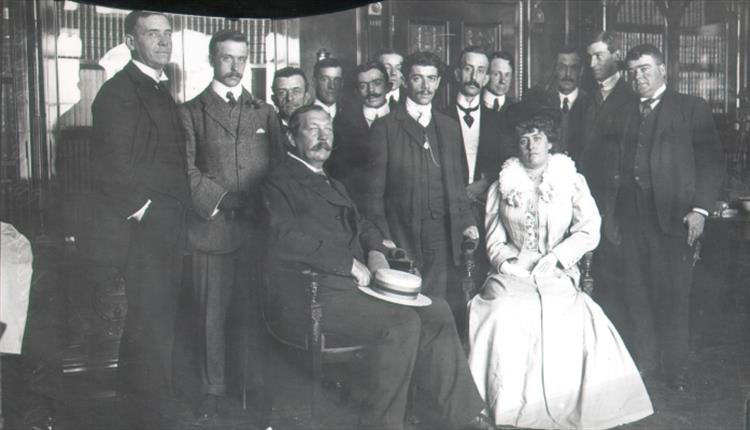
Despite not wining, Pietri’s determination transcended the competition. His story inspired countless runners and became a symbol of the enduring human spirit.
Doyle’s other legacy – Dorando Pietri
While Doyle may be synonymous with Sherlock Holmes, his work during the 1908 Olympics cemented another legacy: the ability to immortalize moments of extraordinary human effort. Pietri’s story, told through Doyle’s vivid words, lives on as a testament to courage, grit, and the triumph of will over adversity.
Here is the rare video of the finish line drama involving Dorando Pietri at the 1908 London Olympics Marathon:
If you enjoyed reading this piece, I’d be grateful if you could share it with your network. More readers mean more motivation and inspiration for a hobby writer like me to continue writing. Thank you!
If you have any thoughts or feedback, feel free to reach out to me at aashutosh[dot]chaudhari[at]gmail[dot]com — I promise to reply!
Discover more from On The Run with Aashu
Subscribe to get the latest posts sent to your email.
 On The Run with Aashu
Thanks Aashu for documenting this account of Sir Arther Conan Doyles beautiful capture of human endeavour through Dorando Pietri. I was not aware of this.
Science and nutrition has since come such a long way to help us complete a marathon but it is these bravehearts who had taken the first steps and showed the way what human endurance can achieve.
LikeLiked by 1 person